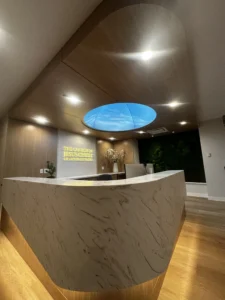
A Stretch Ceiling Instead of Armstrong Tile
Armstrong tile ceilings are everywhere in offices, basements and commercial spaces — and they show their age. Tiles stain, sag and chip, and the grid itself dates the room. A stretch ceiling is the alternative we install most often in their place: a seamless membrane that clips into a perimeter track, with no grid and no tiles to replace.
Armstrong Tile and Stretch Ceiling, Side by Side
Two different ways to finish a ceiling. Here is how they compare, step by step, with the good and the bad of each. Neither one wins everywhere. It depends on the room, the budget, and what is above the ceiling.
1. Installation Process
Armstrong tile: The installer marks the grid lines, fixes a metal angle around the walls, hangs the main runners and cross tees from wires fixed to the structure above, levels the whole grid, then drops the tiles in one by one and cuts tiles around lights and vents.
Stretch ceiling: The installer measures the room, fixes a slim profile around the walls at the chosen height, prepares the spots for lights, then stretches the membrane and clips it into the profile corner by corner until the surface is flat and tight.
Plus and minus: Armstrong uses standard parts and almost any ceiling contractor can install it, but the grid has to be levelled carefully and tile cutting makes dust. A stretch ceiling needs a trained installer and the lights have to be planned before the membrane goes up, but there is no grid to level and no tiles to cut.
2. Time and Disruption
Armstrong tile: A normal room takes one to a few days, depending on the grid layout and how many cuts are needed. The room is usually out of use while the grid goes up.
Stretch ceiling: Most rooms are finished within one day, and the old ceiling usually stays in place, so there is no demolition and very little dust.
Plus and minus: Armstrong is easy to schedule because the materials are on every shelf, but it is slower room by room. A stretch ceiling is faster and cleaner on site, but the membrane is made to measure, so there is a lead time before the install day.
3. The Finished Look
Armstrong tile: You always see the grid and the tile joints. Tiles come in a few standard faces, and the look reads as an office ceiling.
Stretch ceiling: One flat, continuous surface with no grid and no joints. Matte, satin, gloss, printed, or backlit.
Plus and minus: Armstrong gives a uniform, familiar look that suits utility spaces. A stretch ceiling gives the flat, clean ceiling people usually want in homes, restaurants, and finished commercial rooms, but it cannot copy the open grid look if that is what a space needs.
4. Access Above the Ceiling
Armstrong tile: Lift any tile and you are at the pipes, ducts, and cables. This is its biggest strength in offices and commercial buildings.
Stretch ceiling: The membrane can be removed and refitted by an installer when access is needed, and access panels can be planned in, but you cannot just lift a corner yourself.
Plus and minus: For buildings where services above the ceiling need constant access, tile is hard to beat. A stretch ceiling stays practical when access is occasional and planned.
5. Maintenance and Repairs
Armstrong tile: A damaged or stained tile is cheap and quick to replace, one tile at a time. The other side is that tiles stain, sag in humidity, and chip at the edges, so replacements are a regular job.
Stretch ceiling: The membrane wipes clean, does not stain, and carries a 10 year warranty. If it is cut or punctured, the repair is a specialist job, and a large tear can mean replacing the sheet.
Plus and minus: Armstrong wins on cheap, simple spot repairs. A stretch ceiling wins on how rarely it needs attention.
6. Moisture
Armstrong tile: Standard tiles absorb water. One leak from above usually means stained tiles that have to be changed.
Stretch ceiling: The membrane does not absorb water, so a leak does not stain it, and the surface wipes dry.
Plus and minus: In basements and rooms with pipes above, the stretch ceiling avoids the classic leak stain problem. Armstrong tile in a dry, serviced office space does not face that problem as often.
7. Lighting
Armstrong tile: Standard troffer lights drop into the grid, and changing them later is simple. The choice of looks is limited to what fits the grid.
Stretch ceiling: Light lines, slim profiles, pot lights, and full backlit panels are built into the ceiling itself, planned with the ceiling as one design.
Plus and minus: Armstrong is flexible with standard fixtures over time. A stretch ceiling gives far more lighting design, but the lighting has to be decided before installation.
8. Cost Shape
Armstrong tile: Lower material cost and simple labour, so the first price is lower. Ongoing tile replacements and repainting of stained sections add up over the years.
Stretch ceiling: Higher first cost per square foot, because the membrane is custom and the installer is a specialist. After that, there is almost nothing to spend on it.
Plus and minus: Armstrong is cheaper to start. A stretch ceiling costs more once and then stays finished.
Both are suspended ceilings, and both hide what is above them. The difference is what you see every day: a grid of tiles, or one flat surface. If the flat ceiling is the goal, that is the ceiling we install at Space Ceiling, and we measure, make, and fit it with our own crew.
Stretch Ceilings vs Armstrong Ceilings
1. Installation With Minimal Disruption
Stretch ceilings install below the existing ceiling, so in most cases there is no demolition and no need to tear out the old grid. Some projects are completed within one day.
2. Maintenance
There are no tiles to stain or replace. The membrane wipes clean, has no seams to crack and never needs repainting — and it carries a 10-year warranty.
3. Acoustics
For rooms where sound control matters — offices, meeting rooms, home theatres — acoustic membranes with backing can be specified into the ceiling build-up. See our commercial ceiling systems for what is available.
4. Moisture
The membrane does not absorb water, so a leak above will not leave the stained tile that gives Armstrong ceilings away. It is a practical choice for basements and other spaces where moisture is a concern.
5. Design Flexibility
Matte, satin and glossy finishes, printed visuals, backlit panels — and no visible grid breaking up the surface. The ceiling reads as one continuous plane, which changes how the whole room feels.
6. Integrated Lighting
LED profiles and light lines can be detailed into the ceiling itself rather than surface-mounted afterward — linear runs, perimeter glow or fully backlit panels.
7. Long-Term Finish
The membrane is covered by a 10-year warranty, and unlike a tile ceiling it never needs repainting. One installation, and the ceiling stays finished.
A real install: a clean white stretch ceiling going in — the same kind of ceiling that replaces a dated Armstrong tile grid.
Is a Stretch Ceiling Right for Your Space?
Whether it is a stained office grid, a basement tile ceiling or a full commercial floor, the starting point is a site measurement — $150 in Calgary, $200 outside, credited in full if you proceed. Contact us or call (403) 869-9454 for a quote.